Niuean Artists - Questions
Please read the article on here before answering the questions.
1) Who are the four artists we are learning about today?
→ john pule, Lina marsh, cora-Allan wickliffe,foufili halagigie.
2) What school did John Pule attend in Auckland?
a) Tamaki College
b) Selwyn College
c) Mount Albert Grammar
d) St Kents
3) What does John Pule’s art comprise of?
a) Painting on canvas and barkcloth
b) Drawing on canvas
c) Painting on canvas
d) Painting on barkcloth
4) What art is Foufili Halagigie known for?
a) Hiapo
b) Painting
c) Knitting
d) Lili Fakamanaia (Wall Hangings)
5) Describe the Lili Fakamanaia:
→ it has a flower in the middle and diamonds on the sides.
6) In what countries has Cora-Allan Wickliffe’s art been shown?
→ australia,niue,england and canada.
7) What is Cora-Allan Wickliffe known for creating and where are her collections shown in NZ?
→ at the nz museum te papa.
8) Macksoul Art is known for what kind of art?
a) Painting
b) Drawing
c) Hiapo
d) Weaving
Niuean History- Questions
Please read the article on Niue here before answering the questions.
1) This week it is _____ language week.
a) Samoan b) Tongan
c) Fijian d) Niuean
2) What is Niue often referred to as?
a) The sun spot of Polynesia b) The Rock of Polynesia
c) The tiny island nation d) The heart of the Pacific
3) Who was the first European settler to sight Niue?
a) Captain James Cook b) Captain Jack Sparrow
c) Captain James Busby c) Captain Hook
i) When did he sight Niue?
→ 1744
4) What is the name of the Niuean bark cloth?
a) Hiapo b) Tapa Cloth
c) Print d) Patterns
5) Describe what a motif is:
→ spirals,squares,triangles, and concentric.
6) Niueans were the first to introduce what to their hiapo?
a) Animals b) Names
c) People d) Flowers
7) How many attempts did Captain Cook make to land in Niue?
a) Three b) Two
c) None d) One
i) Why do you think the people of Niue refused to let him set foot on shore?
→ because they thinks hes going to attack them.
Niuean History
Sourced from Kiddle and Kahn-Academy
Facts:
Niue is an island country in the South Pacific Ocean. It is 2,400 kilometres north west of New Zealand. Niue is often referred to as the “Rock of Polynesia.” The capital city of Niue is Alofi and the population is 1,626 people.
Brief history:
Niue was settled by Polynesians from Samoa around 900 AD and further settlers arrived from Tonga in the 16th century. The first European to sight Niue was Captain James Cook in 1744, he made three attempts to land in Niue but was refused entry by the people of Niue. No visitors followed Captain Cook for decades until 1830 with the arrival of the London Missionary Society. In the late 1800’s Niue reached out to Queen Victoria to help as they believed their island nation would be taken over by other settlers. A British Protectorate was put in place however Niue was brought within the boundaries of New Zealand on 11th June 1901 which limited the island to the coordinates of its area. Self government was restored by New Zealand in 1974 where Niue chose to self govern the county. Niue is now a free governing state in free association with New Zealand. New Zealand conducts most diplomatic relations on behalf of Niue.
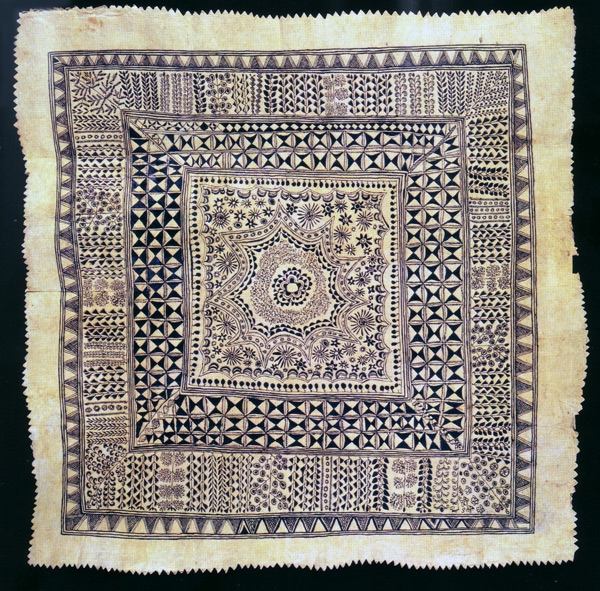
Hiapo: Niuean bark cloth
Little is known about early Niuean bark cloth or hiapo. The missionaries that arrived in 1830 from the London Missionary society brought with them Samoan missionaries who are believed to have introduced bark cloth to Niue. The earliest examples of hiapo were collected by missionaries and are dated to the second half of the nineteenth century. Niuean ponchos (tiputa) collected during this time are based on a style that had been previously introduced to Samoa and Tahiti. It is believed Niueans had a native tradition of bark cloth prior to the arrival of missionaries to the island nation.
In the 1800’s a distinctive style of hiapo decorations emerged that incorporated fine lines and new ideas. Hiapo from this time are illustrated with complicated and detailed geometric designs. The patterns were composed of spirals, squares, triangles and concentric circles. A recurring pattern (motif) decreased in size from the border to the centre of the art work. Niueans created naturalistic motifs and were the first Polyneasians to introduce depictions of human figures into their bark cloth. Some hiapo examples include writing which is usually names which run along the edge of the overall design.